Memoriam (2026) | collaboration with Alex Lyle
Concrete is generally regarded as a structural material. Here we regard it as an archive and a memoriam.
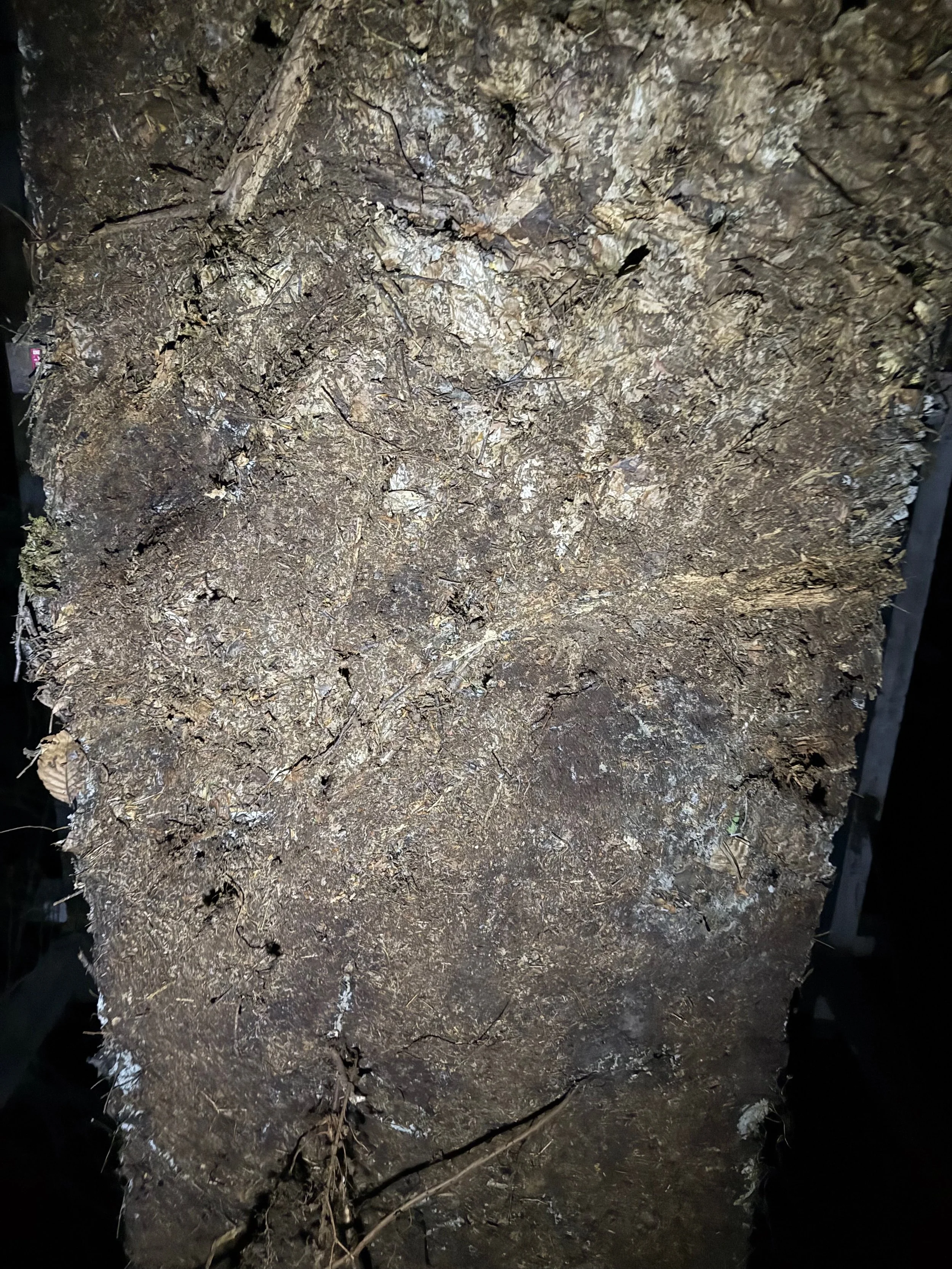
Poured mid-June, right now the concrete slab is fresh. It will cure, already suspended from steel beams for several more months. Its top will gather detritus, eventually hanging as a piece of the forest floor — ferns and saplings slowly gripping into its upper plane. Its lower plane preserves a reflection of the forest floor from the day of its casting.
Historically tablets were for imprinting information.
In place of clay the concrete tablet steps in to create a fast-fossil. Like a clay tablet, the concrete tablet records by imprint, extending our memory, memorializing what would otherwise be lost.
What would be a stroke of a tool is here a branch or a thick blade of grass. What is impressed is the work of the earth, the soil, sun, wind, and water.
But we are also reminded that concrete erases.
Concrete’s violence comes from its power to crush and displace.
Displacing ground in order to mine its components. Displacing vegetation and soil for plants to grow. Displacing communities who hold the land sacred. Displacing animal life. Displacement of water.
And crushing.
When we were making this piece I had in mind the bodies of those crushed by bombs and buildings in Gaza, and the shapes of graves being dug in Congo.
Just two days after we raised the piece, a massive earthquake struck Caracas. In the city my mother was born, slabs of concrete were arrayed like fallen dominos. Once roofs, and floors — now graves.
In my industrial work we talk about 2 ton motors. The news talks about 2 ton bombs. Here we cast 2 tons of reinforced concrete.
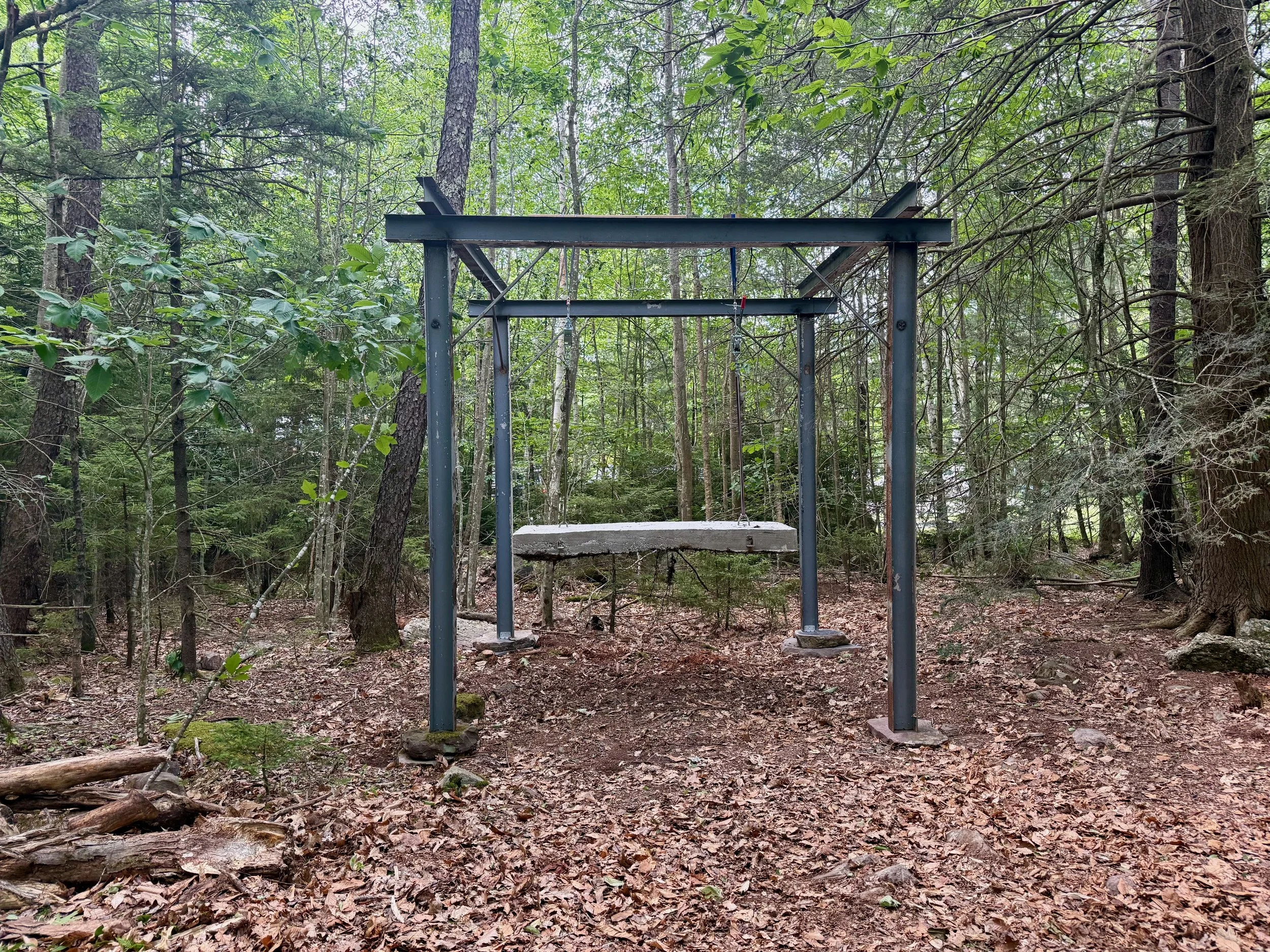
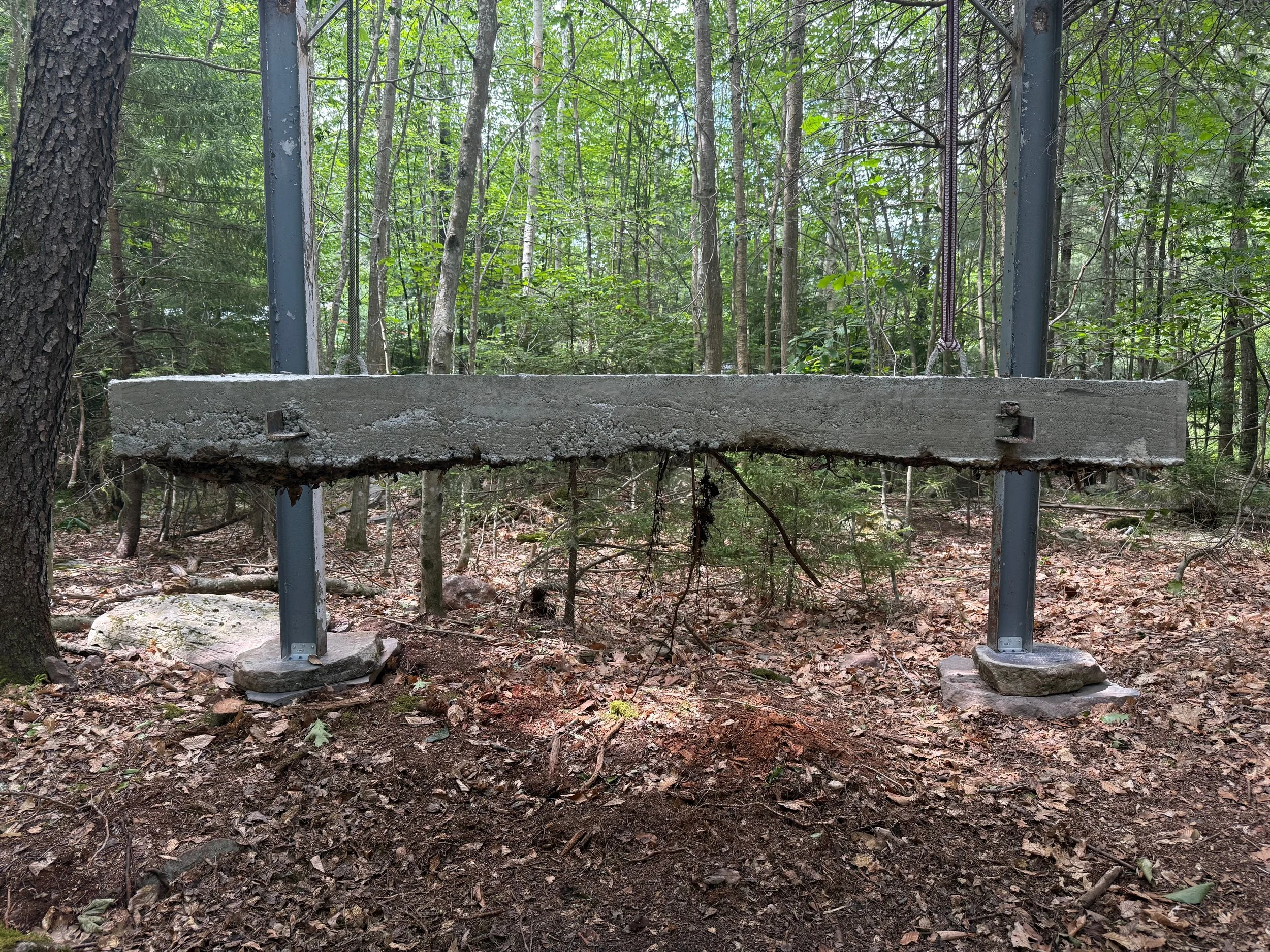
Concrete Architecture & Ungrounding
Memoriam, both the concrete and the structural steel frame that supports it, engages architecture’s fraught history with its own materials. Well before concrete had time to begin it’s exponential spread, the Smithsons perceived Brutalism and its use of untreated concrete as “an architecture of truth” because like the social forms it was tied to, it resented and rejected artifice. Similarly, in the terrain tablets, the surface is not treated so much as unveiled. A chaos of organic material leaves behind sharply defined cellulose patterns and flows. Yet, these slabs are destructive molds killing whatever they capture. The realities of concrete’s social costs are inherent to the material itself.
In Eyal Weizman’s 2025 book Ungrounding, practices of building are staged in direct contrast with that of destruction. He shows how Israel learned from the successes of European Jews who rebuilt their homes after Nazi raids, and ensured those in Palestine would never achieve such a homecoming after the Nakba. As such, beyond structural leveling, foundation lines and field boundaries were annihilated, pushing destruction to the particulate level.
After Warsaw’s leveling in 1944 its people returned, and undertook intensive efforts to reconstruct its home. Plans were smuggled out, fragments of architecture details were kept as reference for new ones, foundations were excavated, and communities sorted useful building materials from the dust in order to rebuild.
By contrast Ungrounding details a series and system for architectural and social erasure that reveals humans no longer as building animals, but animals that destroy. Those left behind or forced underground must navigate the soil itself. When Weizman describes the spatial logic under Gaza he describes a chaos of tunnels — ant-like, but built without the instincts of millennia underground. In parallel, families in Venezuela are tunneling through earthquake rubble to find their loved ones as the government threatens to bulldoze the sites.
While Memoriam is not heavy enough to bear the weight of these experiences, the tension in the cables relieve the pressure upon ground below. Here at least, the crushing weight of the slab is lifted.
References & Further Reading:
Book: Ungrounding (2025) by Eyal Weizman
Article: Concrete Time (2024) by Julie Soleil Archambault
Book: The Social Properties of Concrete (2025)
Website: Understanding the Carbon Footprint of Carbon for Compliance